Self leveling epoxy floor in Edina
A self leveling epoxy floor is a thicker, pourable resin that flows out seamless. It suits shops, showrooms and light industrial space, where a roll-on coat would show the slab's waves and pits. A common wet-grip benchmark for level interior floors walked on wet is a DCOF of 0.42 or more under ANSI A326.3 (2021).[1]
Calls will be recorded.
Last updated
It is a build-up, not a paint.
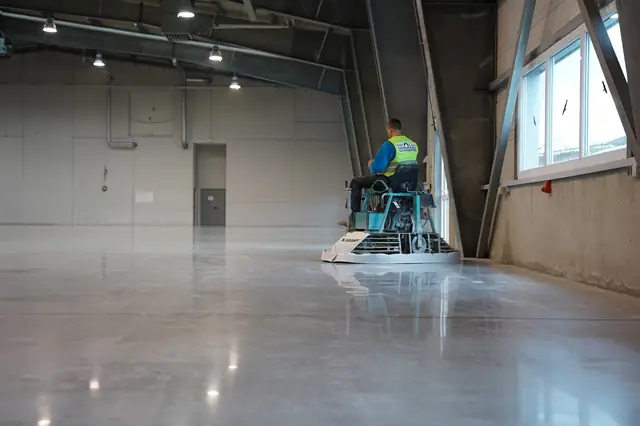

What self leveling means
A standard epoxy coat is thin and follows the slab. Self leveling epoxy is mixed with a filler or aggregate and poured at a greater thickness. Gravity and a squeegee or notched trowel spread it, then a spiked roller releases trapped air.
The result is a flat, glossy floor with few joints. Because it is thicker, it can bridge minor surface texture and give a more even film for rolling carts, forklifts and foot traffic. It does not fix a structural problem. A slab that is cracking or heaving will crack the coating too.
People searching for self leveling floor epoxy often mix up two products. One is a cement-based leveling compound used to flatten a floor before flooring goes down. The other is the resin coating described here. Ask the installer which is being proposed, because they cost and behave differently.
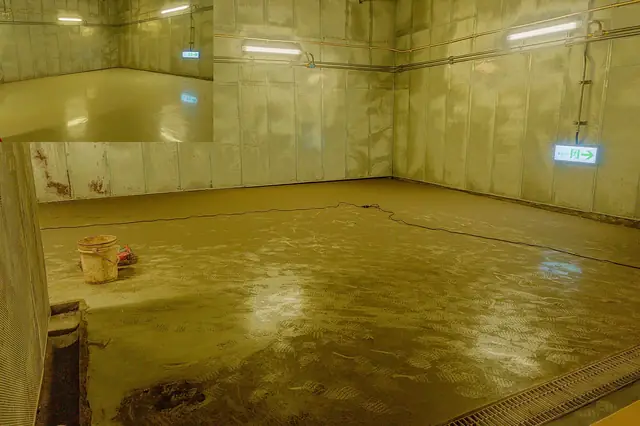

Self leveling epoxy for concrete: where it fits
Self leveling epoxy for concrete works best where the slab is sound but the surface is worn, stained or uneven. Typical uses include:
- Auto and repair shops, where oil and brake dust need a surface that wipes clean.
- Retail and showroom floors that want a polished look without grinding to a high gloss.
- Light manufacturing and warehouse aisles with steady, non-heavy traffic.
- Home workshops and large garages that serve as a small business space.
Edina's commercial areas include two shopping centers and the 50th & France district, which it shares with Minneapolis. The city is more than 95 percent developed.[2] With little open land left, many floors here are existing slabs with a history.
Prep and slab condition
Thicker coatings need the same good bond as thin ones. The slab is ground, vacuumed and repaired. Moisture tests come first. Manufacturer guidance says to test several areas because it is the only valid way to know if the slab is ready.[3]
Older floors may hold oil, which can keep a coating from bonding. Ask how oil-soaked areas are handled. Grinding creates dust, and OSHA's silica standard sets a permissible exposure limit of 50 micrograms per cubic meter as an 8-hour average.[4] A contractor on a commercial site should use a dust-controlled grinder. The concrete preparation page gives more detail.
For a new slab, the common guideline is at least 28 days of cure before coating. It is only a guideline, and the real wait can be much longer.[3]
Ventilation, fumes and occupied buildings
Commercial jobs often happen in buildings where people work. The EPA reports that many VOC concentrations are consistently higher indoors, up to ten times higher than outdoors.[5] Paints and similar coatings contain organic solvents that can release VOCs during use and, to some degree, in storage.[5]
Ask the installer about product chemistry, such as solvent-free or low-odor resins, and about airflow, containment and when the space can be reopened. Plan work around staff, customers and deliveries. A phased schedule often keeps part of the space in use.
Cured epoxy is practically non-toxic unless it is cut, sanded or burned, but the mixed resin can irritate skin, eyes and the respiratory system.[6]
Have a shop or small commercial floor to coat?
Calls will be recorded.
Waste and cleanup
Leftover epoxy, thinner and solvent are not ordinary paint waste. The Minnesota Pollution Control Agency's list for paint collection sites names epoxy, caulk, glue and adhesive as unacceptable, and also excludes thinner, stripper and solvent.[7] That fact sheet is written for collection sites outside the seven metro counties, and it tells metro-county sites, including Hennepin, to check with county staff.[7]
MnDOT manages waste epoxy paint as hazardous in its own operations.[8] A business has more obligations than a household, so ask the installer who takes the waste and where it goes. The regulations page covers permits and licensing in more detail.
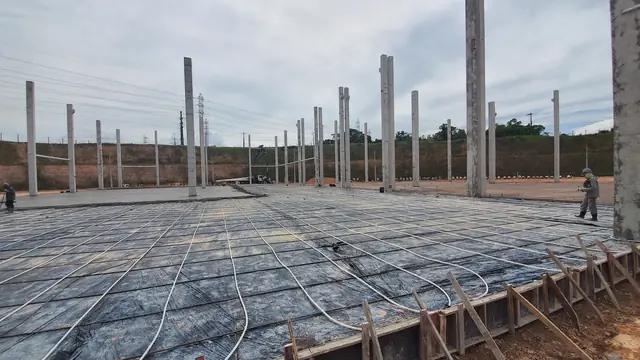

Warehouse floor coatings in Edina
A warehouse floor coating is a resin system on a storage or distribution slab, built to take pallet jacks, forklifts and constant foot traffic. A coatings maker says unsealed concrete slabs often prove insufficient under long-term warehouse use.[9] That is a vendor view.
Hard wheels turning in the same places for years cause dusting, chipped saw-cut joints, oil and battery-acid stains and polished wear lanes. A coating addresses dusting and stains well. It addresses joint damage only if the joints are repaired and detailed first, with flexible fillers for moving joints.
Prep follows the usual order with heavier tools. A coatings-industry article says concrete that is too smooth will not provide enough grip for many warehouse coating products.[10] It adds that coatings will not adhere sufficiently if applied over a dirty floor.[10] OSHA's silica standard limits worker exposure to 50 micrograms per cubic meter as an 8-hour average.[4] So ask about dust collection and wet methods in an occupied building.
A national cost guide says solid epoxy is commonly used in commercial and industrial settings. It is harder to apply and should not go on floors with moisture problems.[11] A coating does not make a workplace compliant by itself.
Walking-working surfaces must be kept in a clean, orderly and sanitary condition.[12] Where mechanical handling equipment is used, aisles and passageways must be kept clear and in good repair,[13] with permanent aisles appropriately marked.[13] Ask how aisle markings will be done and how they will wear.
For a business, downtime is the real cost. A garage epoxy floor can be walked on in about 24 hours. But vehicles should stay off for about a week,[14] while one source says polyurea and polyaspartic coatings let people use a floor again within about a day.[14] Phasing the job by zones keeps part of the building working.
An unheated bay needs heat because epoxy should not be applied below 50 degrees F.[14] The polyaspartic page covers the faster option.
Anti-slip floor coatings
An anti slip epoxy floor coating adds grit or texture to the surface so wet shoes and boots grip better. The common benchmark for level interior floors walked on when wet is a wet dynamic coefficient of friction (DCOF) of 0.42 or greater, unless the flooring maker declares otherwise, from the tile standard ANSI A326.3 as quoted by one manufacturer.[1] The same text warns that 0.42 is not necessarily suitable for all projects, and that the specifier must weigh use, traffic, contaminants and maintenance.[1]
A smooth epoxy floor is not slippery by nature. A home-renovation magazine says dry epoxy is no more slippery than wood. But it can become dangerously slippery when soap or oil-based products spill, and that anti-slip additive costs extra.[15] Minnesota adds a seasonal load, since the Twin Cities average 51.2 inches of snow a year.[16]
Texture comes from broadcast aggregate or a mixed-in additive. One coatings maker's guide says broadcast aggregate choices and textured additives can raise a resinous floor's slip-resistance ratings above the 0.42 minimum.[1] Another manufacturer says its quartz system can be textured for a range of improved-traction finishes.[17] Decorative flakes are chiefly a look, so ask for the tested grip of the whole system.
Grip and cleaning pull in opposite directions. A rough floor grips better and holds grime, while a smooth floor mops easily and slips sooner. Minnesota's food rule makes room for it, with an exception for antislip floor coverings or applications used for safety reasons.[18] OSHA requires workplace surfaces to be kept free of hazards such as spills, leaks, snow and ice,[12] and texture helps but does not replace cleanup. Test a sample wet and ask for the tested DCOF of the exact system.
Commercial flooring contractors: what to ask before signing
A shop owner is choosing who works in the building, not just a product. Minnesota's Department of Labor and Industry lists contractor red flags: full or substantial payment before work, refusing a written contract and no license number.[19] Its suggested contract names who pulls permits, the start and finish dates, a change-order clause and a payment schedule with a modest down payment.[19]
Add the business questions: which zones close and when, how long until forklifts can return, and who removes the waste. Get full lien waivers from each subcontractor and supplier before the final payment.[19]
Cost factors
Published installed prices for epoxy range from $3 to $12 per square foot.[20] Self leveling is a thicker build, so it may sit toward the higher end; ask for an itemized price. Labor can reach 65 percent of the price on a garage epoxy job.[20] Professional floor prep by sandblasting adds $1 to $5 per square foot, according to a national home-improvement site.[20]
Square footage, slab condition, film thickness, color and topcoat all move the total. See the pricing guide for the full list.
Related pages
For storage and distribution space, see the warehouse section above, and for a food business the epoxy kitchen floor page covers Minnesota's cleanability rules. A thicker, gritty broadcast system is described under quartz epoxy floors, and the anti-slip section above explains how traction is measured.
For a decorative, chip-based finish, look at decorative epoxy flooring. For attached garage bays, see garage floor coating. The services overview lists every option, and the contact page explains how calls and requests are handled.
Sources
- Sherwin-Williams High Performance Flooring. A Guide to Slip Resistance for Resinous Flooring, accessed November 23, 2026
- Wikipedia. Edina, Minnesota, accessed November 23, 2026
- Sherwin-Williams. How Soon Can You Epoxy Coat Freshly Poured Green Concrete?, accessed November 23, 2026
- OSHA standard, text hosted by Cornell Legal Information Institute. 29 CFR 1926.1153 Respirable crystalline silica, accessed November 26, 2026
- U.S. Environmental Protection Agency. Volatile Organic Compounds' Impact on Indoor Air Quality, accessed November 23, 2026
- California Department of Public Health. Epoxy Resin Systems fact sheet (HESIS), 1989-06
- Minnesota Pollution Control Agency. Architectural Paint: Management for paint collection sites (w-hw4-37b), 2016-03
- Minnesota Department of Transportation. Management of Paint Wastes, accessed November 23, 2026
- Sherwin-Williams High Performance Flooring. Resinous flooring for logistics facilities, accessed November 23, 2026
- Painting & Coating Industry (PCI) magazine. How to Achieve Durable and Long-Lasting Coatings for Warehousing Facilities, accessed November 23, 2026
- HomeGuide. How Much Does Epoxy Flooring Cost? (2026), February 3, 2026
- U.S. Occupational Safety and Health Administration. 29 CFR 1910.22 General requirements (walking-working surfaces), accessed November 23, 2026
- U.S. Occupational Safety and Health Administration. 29 CFR 1910.176 Handling materials - general, accessed November 23, 2026
- ConcreteNetwork.com. What's the Best Concrete Garage Floor Coating? Epoxy, polyurea, or polyaspartic, accessed November 23, 2026
- This Old House. How Much Does Epoxy Flooring Cost?, accessed November 23, 2026
- Minnesota Department of Natural Resources State Climatology Office. Twin Cities normals: 1991-2020 compared to 1981-2010, May 6, 2021
- Sika. Sikafloor Quartzite Broadcast System product data sheet (Sept 2023, v01.04), accessed November 23, 2026
- Minnesota Office of the Revisor of Statutes. Minnesota Rules 4626.1335 Floors, walls, and ceilings; cleanability, accessed November 23, 2026
- Minnesota Department of Labor and Industry. A consumer's guide to Hiring a Residential Building Contractor, accessed November 23, 2026
- Bob Vila. Epoxy Garage Floor Cost, April 26, 2024