Basement floor coating in Edina
Basement floor coating is the one job where slab moisture and radon matter more than the finish. The Minnesota Department of Health recommends that every Minnesota home be tested for radon; as of January 2026 it finds elevated levels in about 40 percent of them, entering through cracks in the slab.[1][2] Test and fix first, then coat.
Calls will be recorded.
Last updated

Why basements are different
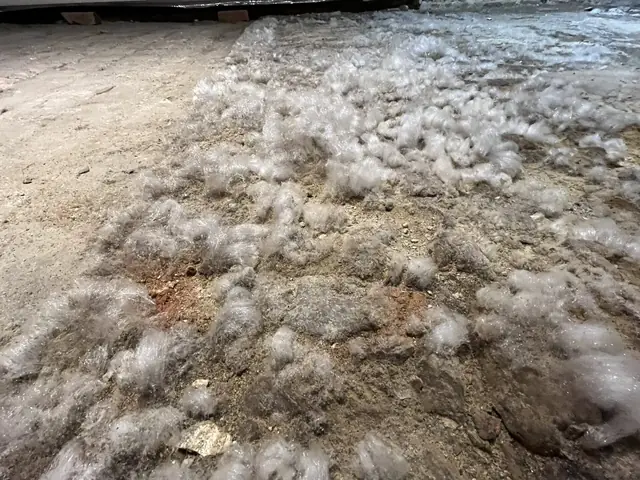
A garage slab sits at the edge of the house. A basement slab sits under it, in direct contact with soil. That contact brings water vapor and soil gas up through the concrete all year, even when the floor looks dry.
Older slabs are common in Edina, where 68 percent of housing units were built before 1980.[3] You cannot tell how a slab behaves by looking at it. A coating that goes on a damp floor can blister, peel or trap moisture and produce a musty smell.
Test the slab's moisture before you coat a basement
Any epoxy floor coating for a basement should start with moisture tests. Manufacturer guidance says to test several areas of a slab, because that is the only valid way to tell if it is ready.[4] It names three common methods: in-situ relative humidity probes (ASTM F2170), calcium chloride (ASTM F1869) and a plastic sheet test (ASTM D4263).[4]
The simplest home check is the plastic sheet test: tape a clear sheet to the floor and look for condensation after a day. It is a screen, not a substitute for the lab-style tests.
High moisture in the slab can make epoxy bubble, peel or fail to bond, because the moisture gets trapped under the film.[5] Polyaspartic has the same weakness and can bubble and lift.[6] If readings are high, a moisture-mitigating primer or barrier is the usual answer, and it adds cost. A national home-improvement site puts a needed barrier under polyaspartic at about $1 per square foot.[7]
Radon and the slab
About 40 percent of Minnesota homes have elevated radon, according to the Minnesota Department of Health (January 2026).[2] MDH says radon enters through cracks in the slab, floor-wall joints, open sump pits and crawl spaces. It notes that a basement offers a large area in contact with soil.[1]
A coating is not a radon system. The EPA's radon-resistant construction guidance does include sealing cracks and openings in the foundation floor. It is only one part of a system that also includes venting.[8] A coating can help seal a floor, but it should not be sold as a fix.
Practical steps:
- Test for radon before you spend money on the floor. For a real estate sale, MDH says the test goes in the lowest occupiable level, which is typically the basement, finished or not.[9]
- Follow MDH's retest rules. Under 2 pCi/L, retest in 2 to 5 years. From 2 to 7.9, do a long-term test. At 8 or more, do a short-term follow-up.[10]
- If levels are high, talk to a radon mitigation provider before or alongside the coating job.
- Ask the coating installer how cracks, floor-wall joints and the sump area will be handled.
Planning a basement floor and not sure where to start?
Calls will be recorded.

Which coating suits a basement
Basements stay cooler and out of the sun, so UV is rarely an issue. That makes the choice mostly about looks, moisture and downtime.
- Solid-color epoxy. The simplest choice, and a common one to pair with a moisture primer.
- Flake systems. Good for a workshop or laundry area. See decorative epoxy flooring.
- Metallic epoxy. A strong look for a finished rec room. The metallic epoxy page shows how it is made.
- Polyaspartic. Fast, but only with passing moisture results. Read the polyaspartic page before deciding.
Sump pits, drains and floor cracks
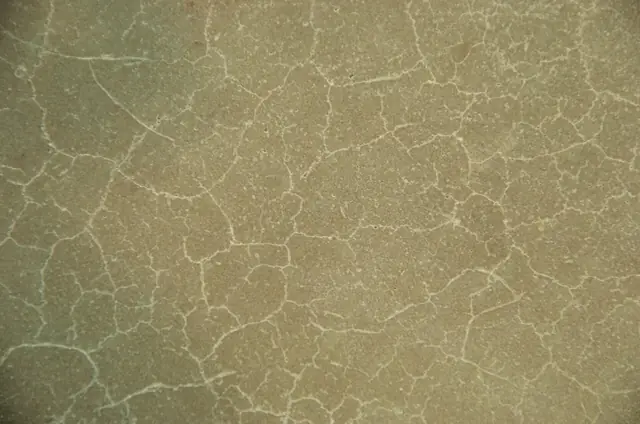
Basements have features garages lack. A floor drain needs to stay open, so the coating should stop at its edge. A sump pit needs access. Cracks near the wall can move with seasons and may need a flexible repair material, not a rigid filler.
Ask the installer to point out every crack and joint before work starts, and to explain what goes in each one. The concrete prep and crack repair page explains why cracks are repaired before coating.
Ventilation and fumes
Closed basements hold fumes. The EPA reports that indoor concentrations of many volatile organic compounds are consistently higher than outdoors, up to ten times higher.[11] Paints and similar products can release them during use.[11] Ask the installer how the space will be ventilated, whether low-odor products are used and when you can safely reoccupy the room.

Kitchen epoxy floors in Edina
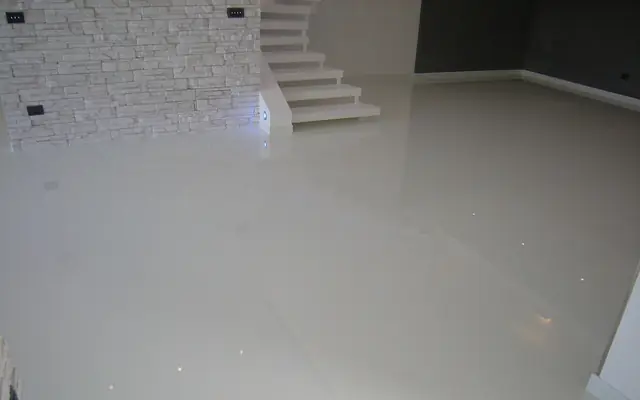
An epoxy kitchen floor is a seamless coating that replaces grout lines and seams with one wipeable surface. One national source (February 2026) puts it at $400 to $2,000 installed for 100 to 200 square feet. It calls it uncommon but easier to clean than some other flooring.[12] A home kitchen and a food business follow different rules.
In a house, the first question is whether the kitchen floor is a concrete slab at all. Many sit over wood framing, and epoxy works best on concrete, so over wood or tile it needs a different plan.
For a food business, Minnesota's food code rule says floors must be designed, constructed and installed so they are smooth and easily cleanable.[13] The Department of Agriculture adds that floors in preparation, open-food and dishwashing areas must be smooth, durable, nonabsorbent, grease-resistant and easily cleanable.[14] It also requires a cove base with a smooth radius transition at all floor and wall junctions.[14] That page lists poured flooring systems among approved floors and describes that type of flooring as not a sealant or a coating.[14] It gives a thickness of 1/8 to 3/8 inch.[14]
A thin garage-style coating should not be assumed to count. So a food business should ask its licensing authority and submit its plans before it picks a product.
Grip matters in a wet, greasy room, and Minnesota's rule allows antislip floor coverings or applications for safety reasons.[13] See the anti-slip coating section for how to choose.
Epoxy can take up to a week to cure. Meanwhile, polyaspartic cures in one to two days, per a national cost guide,[15] which matters when a kitchen cannot close for long. The polyaspartic page explains the faster option. Ventilation matters too, since EPA reports that concentrations of many VOCs are consistently higher indoors, up to ten times higher, than outdoors.[11]
Coating over tile and bathroom floors
Epoxy over tile floor work is possible, but it depends on bonding to a glazed, slick surface and hiding the grout lines. One tile-primer data sheet warns that inadequate preparation will lead to loss of adhesion and failure.[16] It says sound grout joints should be treated with additional primer to bring them level with the tile surface and prevent the grout lines reflecting through.[16] It also says the floor should be thoroughly degreased before mechanical treatment.[16]
Loose, cracked or hollow-sounding tiles must be fixed first, because a coating cannot hold a loose tile down. Ask to see a sample over tile, since a textured finish may hide a grid better than a smooth one.
Older homes need a pause. Edina's median home was built in 1971.[3] The Minnesota Department of Health says flooring, including sheet vinyl, floor tiles and their backing, adhesive or glue, can contain asbestos.[17]
MDH says that if asbestos-containing flooring is in good shape and not damaged, new flooring may be installed over it.[17] It strongly recommends a Minnesota-licensed asbestos contractor to remove it.[17] Have vinyl or resilient tile tested before any grinding.
A bathroom adds water, soap and bare feet. A smooth epoxy can be dangerously slippery when soap or oil-based products spill,[18] and the tile standard sets a wet DCOF of 0.42 or greater as the benchmark for level interior floors that get wet.[19] Also ask about drains and door clearances, and do not coat a shower pan, which is a waterproofing system, without the manufacturer's approval.
Cost and timing
Basement floors are usually smaller than garages, but prep can be harder because of stains, glue and furniture. Published epoxy prices are $3 to $12 per square foot installed, according to a national home-improvement site (April 2024).[20] The pricing guide breaks out how moisture work and repairs change the total.
Basement stairs raise their own grip questions, covered under epoxy stairs and steps. A wet laundry or bath area is a slip question. So read about anti-slip epoxy coatings, and an old tiled basement floor is covered in the tile section above.
For permit and licensing questions, see the regulations page. To compare with other options, browse the services overview or return to the home page.
Sources
- Minnesota Department of Health. Radon in Homes, accessed November 23, 2026
- Minnesota Department of Health. News release: radon testing during home real estate sales (page dated Jan. 13, 2025; listed in MDH's 2026 releases as Jan. 13, 2026), January 13, 2026
- U.S. Census Bureau (ACS 2024 5-year, via Census Reporter). American Community Survey 2020-2024 5-year estimates for Edina city, MN (served by Census Reporter API), accessed November 23, 2026
- Sherwin-Williams. How Soon Can You Epoxy Coat Freshly Poured Green Concrete?, accessed November 23, 2026
- Synchrony. How Much Does Epoxy Flooring Cost?, April 20, 2026
- ConcreteNetwork.com. What's the Best Concrete Garage Floor Coating? Epoxy, polyurea, or polyaspartic, accessed November 23, 2026
- Bob Vila. Polyaspartic Floor Coating Cost, January 31, 2024
- U.S. Environmental Protection Agency. Radon-Resistant Construction Basics and Techniques, accessed November 23, 2026
- Minnesota Department of Health. Radon in Real Estate, accessed November 23, 2026
- Minnesota Department of Health. Radon test results, accessed November 23, 2026
- U.S. Environmental Protection Agency. Volatile Organic Compounds' Impact on Indoor Air Quality, accessed November 23, 2026
- HomeGuide. How Much Does Epoxy Flooring Cost? (2026), February 3, 2026
- Minnesota Office of the Revisor of Statutes. Minnesota Rules 4626.1335 Floors, walls, and ceilings; cleanability, accessed November 23, 2026
- Minnesota Department of Agriculture. What are approved finish materials for floors, walls, and ceilings?, accessed November 23, 2026
- HomeGuide. How Much Does Concrete Coating Cost? (2026), November 25, 2024
- Altro. Altro Prime Ceramic technical data sheet, accessed November 23, 2026
- Minnesota Department of Health. Residential Floor Tile Removal, accessed November 23, 2026
- This Old House. How Much Does Epoxy Flooring Cost?, accessed November 23, 2026
- Sherwin-Williams High Performance Flooring. A Guide to Slip Resistance for Resinous Flooring, accessed November 23, 2026
- Bob Vila. Epoxy Garage Floor Cost, April 26, 2024