Epoxy floor coating services in Edina
Epoxy floor coating services range from a single-color garage floor to metallic showpiece basements, and all of them start with ground, dry, repaired concrete. A home-renovation magazine (March 2026) publishes contractor-installed epoxy at about $3 to $12 per square foot,[1] and each system below has its own page.
Calls will be recorded.
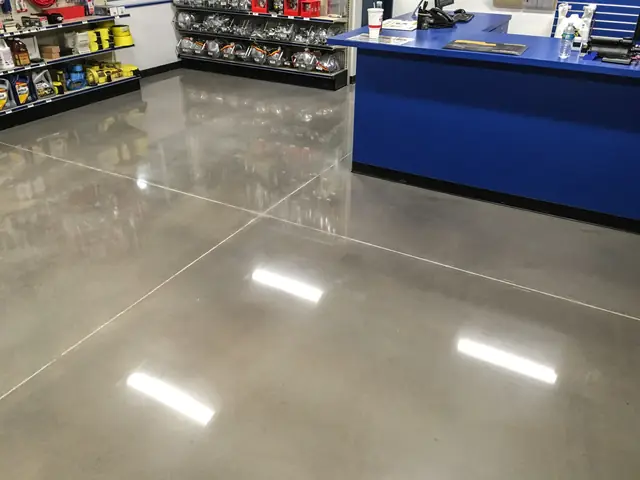
Photo: "Polished Concrete Floor" by Intellicents, CC BY-SA 4.0, via Wikimedia Commons, adapted

Pick the floor you are working on
Garage floor coating
How garage floor coating works on an Edina slab: cure times, the 50 F rule for cold garages, what moves the price and what to ask the installer.
Flake and quartz floors
Decorative epoxy flooring in Edina: flake systems and thicker quartz floors, what they are made of, slab needs, grip, topcoat costs and lifespan.
Metallic epoxy floors
A metallic epoxy floor in Edina: how pigment swirls form the epoxy marble look, why white epoxy floor shows flaws, and what the published price range covers.
Polyaspartic one-day coatings
Polyaspartic garage floor coating in Edina: back in use in about a day, UV stable, but sensitive to slab moisture.
Basement, kitchen and bath floors
Basement floor coating in Edina starts with moisture and radon.
Shop, warehouse and anti-slip floors
Self leveling epoxy floor basics for Edina shops, plus warehouse floor coatings and anti-slip textures: forklift wear, OSHA rules and wet-floor grip.
Concrete prep, crack repair and sealing
Preparing concrete for epoxy in Edina: grinding, silica dust rules, moisture tests, crack repair and when sealing the slab beats a coating.
Patios, driveways and steps
An outdoor epoxy floor for an Edina patio, explained: sun yellowing, freeze-thaw, slip risk and what installed prices cover, plus driveways and steps.
Last updated
Guides for residential floors and commercial coatings
This site covers the kinds of work Edina homeowners and small shops commonly ask about. The work is done by independent businesses, and each page explains what the system is, where it fits and what to ask before you hire.
- Garage floor coating is where many people start: one-, two- and three-car slabs, and what winter salt does to them.
- Flake and quartz floors compare a speckled chip finish with a thicker broadcast quartz system.
- Metallic epoxy floors swirl pigment into a marble-like surface, at $5 to $12 per square foot in published ranges.[1]
- Polyaspartic one-day coatings return a floor to use in about a day.[2]
- Basement, kitchen and bath floors begin with moisture and radon, and also take in home kitchens, food-business floor rules and coating over tile.
- Shop, warehouse and anti-slip floors handle self-leveling pours, forklift wear, aisle marking and wet-floor traction.
- Concrete prep, crack repair and sealing covers grinding, repairs and dust control, and when a clear sealer is enough.
- Patios, driveways and steps face sun, rain and ice, so they get their own advice on topcoats, texture and stair dimensions.
Where installers apply these coatings
Installers coat garages, basements, kitchens, patios, driveways, steps and shops, and each place sets its own limit. A garage is cold and salted. A basement needs a moisture check, and the Minnesota Department of Health says radon is elevated in about 40% of Minnesota homes.[3] An outdoor slab faces sunlight that can turn epoxy yellow.[1]
A shop adds forklift wear and traction rules. The page for each place lists what to ask before any resin is mixed.
Why Minnesota winter shapes each system
The Twin Cities' normal January temperature is 16.2 F,[4] and the monthly normals stay below freezing from December through February.[4] Road crews put 190,758 tons of salt on state roads in winter 2025-26.[5] Every coating in this guide has to survive that cycle, which is why timing, slab temperature and deicer exposure come up on each page.
How do I choose between these floor systems?
Start with where the floor is and how it is used. A garage that sees salt, hot tires and sun has different needs than a dry basement rec room.
The Twin Cities' normal snowfall is 51.2 inches a year,[4] so garage floors in Edina take a lot of wet, salty traffic.
Then check the slab. Edina's median home was built in 1971,[6] so many slabs are old and need repair before any system goes on. A moisture test comes next, since high moisture in a slab can make epoxy bubble, peel or fail to bond.[7]
Finally, think about timing. A garage epoxy floor can be walked on after about 24 hours, but vehicles should stay off for about a week.[2]
What every system has in common
Whatever the finish, the sequence is the same: grind, repair, test moisture, coat, seal and cure. A typical garage job takes about a day for prep, a day to coat and a day to seal.[8] Differences between systems show up in thickness, color options, cure speed and cost, not in whether prep matters.
An epoxy system is a resin plus a hardener mixed on site,[9] so working time is short and conditions matter. That is why a careful installer asks about slab temperature, moisture and ventilation before mixing a bucket.
Which page to read first
Match the page to the problem in front of you rather than the finish you saw online. If the floor is cracked, scaling or stained with oil, begin with the concrete prep page. Every system here depends on what the slab looks like underneath. If the slab is sound, the sealing section on that page may be all you need to keep salt and water out.
Garage owners usually weigh three finishes against each other. Chips give a forgiving look, metallic pigment makes a showpiece, and a polyaspartic topcoat means a short wait. Basement owners should read the moisture and radon material first, since about 68 percent of Edina's housing units were built before 1980.[6] Older slabs have had decades to crack and absorb water. A shop owner has a different list: forklift lanes, aisle markings, traction and how long the building can stay closed.
Whatever you choose, the hiring advice is the same. Minnesota's Department of Labor and Industry suggests a payment schedule with only a modest down payment.[10] It also says final lien waivers from every subcontractor and supplier should come before the last payment.[10] Ask each independent business how it will grind, which moisture test it will run and what the written scope says. This site does not set prices or pick a business for you, so treat these pages as a checklist for the call.
Related reading
For prices see the epoxy floor cost page, and for permits and licensing see the regulations page. The common questions page covers short answers, and the home page gives the overview.
Sources
- This Old House. How Much Does Epoxy Flooring Cost?, March 13, 2026
- ConcreteNetwork.com. What's the Best Concrete Garage Floor Coating? Epoxy, polyurea, or polyaspartic, accessed November 23, 2026
- Minnesota Department of Health. News release: radon testing during home real estate sales (page dated Jan. 13, 2025; listed in MDH's 2026 releases as Jan. 13, 2026), January 13, 2026
- Minnesota Department of Natural Resources State Climatology Office. Twin Cities normals: 1991-2020 compared to 1981-2010, May 6, 2021
- Minnesota Department of Transportation. Winter Maintenance Report, accessed November 23, 2026
- U.S. Census Bureau (ACS 2024 5-year, via Census Reporter). American Community Survey 2020-2024 5-year estimates for Edina city, MN (served by Census Reporter API), accessed November 23, 2026
- Synchrony. How Much Does Epoxy Flooring Cost?, April 20, 2026
- Bob Vila. Epoxy Garage Floor Cost, April 26, 2024
- California Department of Public Health. Epoxy Resin Systems fact sheet (HESIS), 1989-06
- Minnesota Department of Labor and Industry. A consumer's guide to Hiring a Residential Building Contractor, accessed November 23, 2026